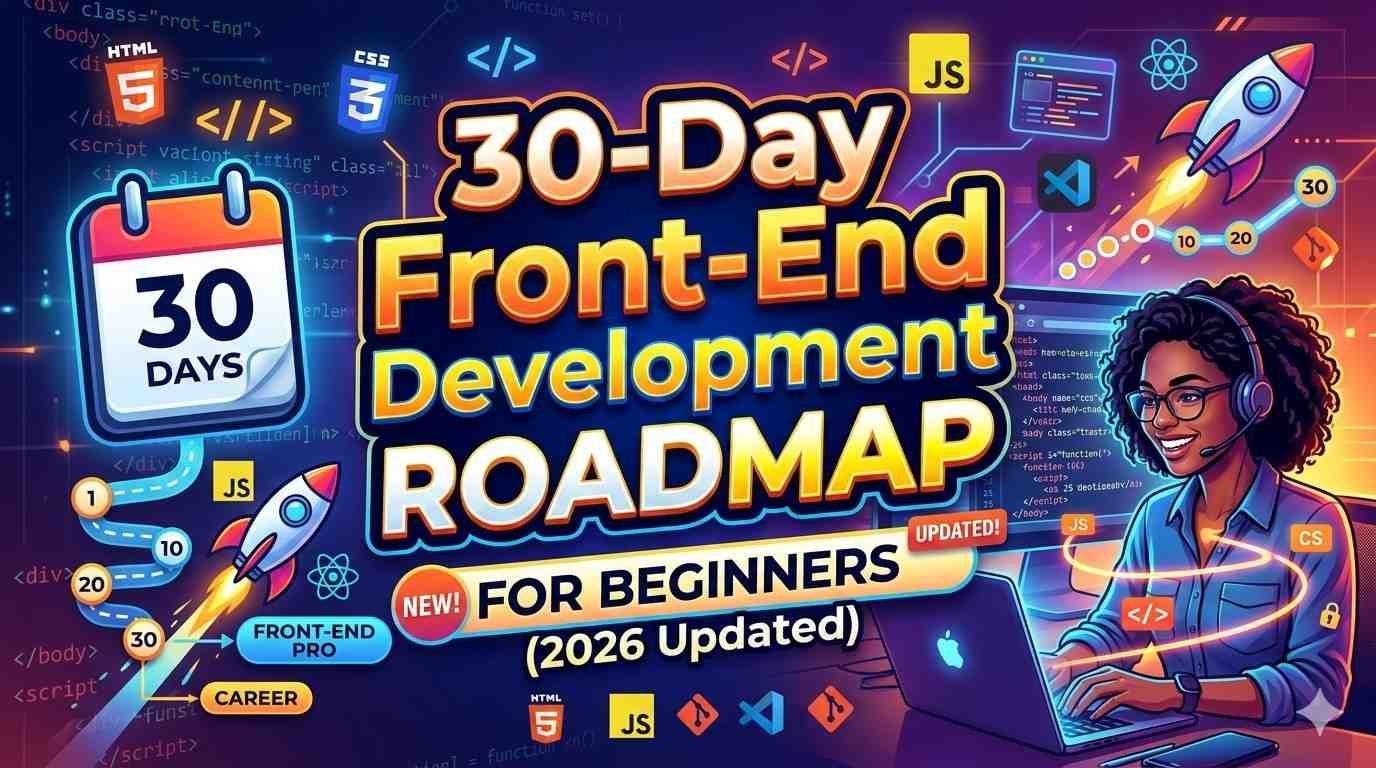
In the tech industry, Front-End Web Development is one of the most sought-after skills. Front-end technologies are used to display content and enable user interaction on every website you visit. Using HTML, CSS, and JavaScript, front-end developers create websites’ visual elements. Modern, responsive, and interactive web experiences are made possible by the combination of these technologies.
Why Front-End Web Development?
Learning Front-End Web Development can be difficult if you’re just getting started because there are so many tools and frameworks to choose from. The best strategy is to regularly practice and follow a clear learning path. This 30-day Front-End Web Development plan will help you build real projects as it takes you from the fundamentals for beginners to more complex ideas.
Week 1: Learn the Basics of HTML.
Every website’s foundation is HTML.
It organizes content such as text, images, forms, and links while also defining the structure of web pages.
What to know:
Structure, headings, paragraphs, links, images, lists, tables, forms, and semantic HTML are all elements of HTML documents.
Exercise task:
Create a straightforward personal profile page with your name, picture, brief bio, and contact form.
Fundamental ideas:
SEO-friendly markup, accessibility fundamentals, semantic tags, and HTML5. Free materials HTML guides from the Mozilla Developer Network, W3Schools HTML tutorial, and freeCodeCamp HTML course.
Week 2: Master CSS Styling
CSS is the next skill to acquire after learning HTML structure. CSS controls the visual design of your website, such as colors, spacing, layout, and fonts.
What to learn
CSS syntax, selectors, colors, typography, the box model, margins, padding, and borders.
Layout skills
Flexbox layout, CSS Grid layout.
Practice task
Utilize Grid and Flexbox to create a layout for a landing page.
Key concepts
Typography, responsive layouts, and user interface design are all part of CSS3.
Free resources
Responsive Web Design course, freeCodeCamp, MDN CSS documentation, and CSS Tricks tutorials
Week 3: Responsive Design and CSS Frameworks
Websites of today must function on desktops, smartphones, and tablets. Layouts can be adjusted to fit different screen sizes thanks to responsive design.
What to learn
Media queries, mobile-first design, responsive layouts, CSS animations, and media queries. You can also investigate CSS frameworks that accelerate Front-End Web Development. Frameworks offer pre-designed components that speed up the construction of layouts.
Practice task
Build a responsive business homepage.
Key concepts
Responsive design, mobile optimization, Bootstrap, Tailwind CSS.
Free resources
Bootstrap official documentation, Tailwind CSS documentation, freeCodeCamp responsive projects.
Week 4: JavaScript Basics
Websites are given life by JavaScript. It lets developers make interactive buttons, menus, form validation, and dynamic interactions.
What to learn
Variables, data types, conditions, loops, functions, arrays, objects.
DOM skills
Managing user events like clicks, selecting elements, and updating the content of the page.
Practice task
Create a user-friendly, interactive application for to-do lists.
Key concepts
Debugging, the fundamentals of JavaScript, how to manipulate the DOM, and event listeners.
Free resources
JavaScript.info tutorials, the JavaScript course at CodeCamp for free, and the MDN JavaScript guide.
Week 5: Advanced JavaScript Concepts
You can move on to more advanced JavaScript features that are used in modern web applications once you understand the fundamentals of Front-End Web Development.
What to learn
Arrow functions, destructuring, promises, async await, and the fetch API are all ES6 features.
Practice task
Create a weather application that uses a public API to get data.
Key concepts
REST API integration, asynchronous programming, and JSON data handling.
Free resources
JavaScript.info advanced section, freeCodeCamp APIs and microservices course, RapidAPI tutorials.
Week 6: Web Development Tools and Deployment
Tools that make it easier to manage code and publish projects online are used by professional developers.
What to learn
Git version control, GitHub repositories, npm package manager, browser developer tools, website deployment.
Final project
Create a personal portfolio website with a contact form, project gallery, and an “about” section.
Use a hosting service to publish the website online and upload it to GitHub.
Key concepts
Git workflow, version control, deployment, and developer portfolio.
Free resources
GitHub Learning Lab, Git documentation, Netlify deployment guide.